Osborne Reynolds, F.R.S. (1842-1912), a British engineer and educator, earned the respect of his peers and the devotion of his students. Today he is recognized mainly for his contributions to the study of fluid flow (5,6); but Reynolds perceived these as only preliminaries to his grand synthesis - an axiomatic theory of a particulate aether. Reynolds was disappointed because his peers neither understood his theory nor shared his perception of its value (7). Also, he was competing for attention with the many major discoveries which followed one upon the other at the dynamic turn of the century. Now, 76 years later, will Reynolds have a more sympathetic audience?
In 1903 Cambridge University Press published the third volume of Reynolds' collected works, "On The Submechanics of the Universe" (8). This was two years ahead of Einstein's special theory of relativity.
Today, theories of the luminiferous aether are not in vogue among Apologist physicists. They say that the M-M experiment disproved and that relativity theory did away with the need for an aether. It is true that M-M results disproved some aether theories; but the type of aether proposed by Reynolds, far from being disproven, actually permits visualization of the mechanism whereby the speed of light remains a constant. Here is a demonstration.
As Einstein has shown, the observed speed of light is always a constant because the length of an object contracts in the direction of motion and its local time rate slows in perfect balance. Reynolds' theory enables me to show that the mechanism whereby this occurs is inherent in the very structure and dynamics of the medium.
This medium is granular, composed of uniform, spherical grains much smaller than subatomic particles and filling the entire universe. In fact, it is the universe. In matter-free space the grains are hexagonally arrayed and almost close-packed. Because they cannot exchange neighbors, they form a quasicrystalline matrix. The grains are in relative, vibratory, gas-like motion; but with a mean free path many orders of magnitude smaller than the diameter of the grains (unlike a gas). This jostling of the grains against one another produces a very high pressure in the medium. Because of the gearing of the grains and the pressure, the medium supports transverse disturbances (EM waves) whose local propagation rate depends on the local pressure and strains in the medium. Unstrained; i.e., without matter, the aether is isotropic. Strained; i.e., with matter present, it is anisotropic.
Reynolds says matter is strained regions of misalignment of the grains or "singular surfaces", "negative inequalities", or simply, "holes". Matter, then, moves by means of displacement; much as a bubble moves upward by an equal amount of liquid being displaced downward. For holes to move through the medium, aether grains must move in the opposite direction.
BY Bruce L. Rosenberg
http://keelynet.com/osborn/rey4.htm
Wednesday, 12 May 2010

Thursday, 6 May 2010
Hydrogen From Space
Image: House of cards by Alex Clark 
The glow retreats, done is the day of toil;
It yonder hastes, new fields of life exploring;
Ah, that no wing can lift me from the soil
Upon its track to follow, follow soaring!
~~Goethe's Faust
Recently, I came across a post on Sepp Hasselberger's blog that I had first seen more than a year ago. In the post, Sepp gives details about some of the ideas of Dr.Paul Rowe, regarding the aether, and specifically, Rowe's persistence that it could be possible to produce hydrogen from the vacuum of space. This belief is based on his own experience and also past experiments made by pioneering scientists of the 19th Century.
Rowe manages to explain his theory about the aether while also imagining himself as part of an elaborate stage play (where he is taunted by the ghosts of science-past - including Huygens, Maxwell and Einstein - about his snoring, and belief in the existence of the aether). In the play, Rowe makes the very curious statement that "vacuum is not a void and whatever is in vacuum can be converted into hydrogen under surprisingly mild conditions."
I wrote a post in March last year, "House of Cards", which was based on details taken from Rowe's play (the title of the post is taken from the name of the play.) I found the play very interesting, highly entertaining, and it even succeeded in tickling me in places (no easy feat in the midst of discussing physics.) After reading it again last night, I realised just how much the play has influenced my thinking over the past year. For one, it showed me the need to question everything that science bases its assumptions on, and to try and explain my line of reasoning as simply as possible. More importantly perhaps, Rowe also proved to me that you can do all the scientific stuff, without having to take ourselves too seriously.
Most certainly, it was Rowe who drew my attention to the paradox that Maxwell had developed his calculations for EMR whilst using a mechanical model of the aether (he later discarded the model but kept the maths.) It follows that Einstein then used Maxwell's equations to develop his own theories, but as Rowe points out, wasn't he thereby basing them on the same assumptions - mainly, that a vacuum is a physical medium? In one dream sequence, Rowe challenges Einstein's stance on the existence of the aether:
" I’ve heard that you felt your equations described physical phenomena without assuming a physical medium in vacuum. You have been quoted as saying, “If a thing can’t be observed, why should it be necessary to assume its existence?”"
One could argue that Einstein did not so much as deny the existence of the aether, but rather, he argued that to prove its existence was unnecessary. There was something else in the play which caught my eye. I noticed that it might very well have been here that I first picked up on the old "helium-He-God" thing. Below, is a part of the play, where Rowe is talking to J. Norman Collie, a long-since deceased Fellow of the Royal Society, about helium's possible contention as being the very substance of the Universe, and ultimately, God:
" For a while, I thought that the medium (aether), in which many scientists, of your day still believed carried light, might be helium. This would mean the whole knowable universe is permeated with helium. It pleased me to think that the most important thing in the universe was capital H small e, which in this form is the pronoun we use for God."
I think that the timing of me re-discovering Sepp's post, and essentially Rowe's aether theory, is for me personally significant. For over the past year I have been able to learn a few more things regarding aether theory, and today, at last, I am beginning to grasp the importance of what Rowe is saying. If I might be so bold, having developed some of my own ideas on the aether over the past year, I think that I might be able to add something to the picture being painted by Rowe. Below, is a paragraph, written by Rowe, which seems to encapsulate the most radical idea in his aether theory:
" I am convinced that hydrogen gas has been created from vacuum. This leads me to suspect that vacuum contains something from which hydrogen can be produced. Other observations led me to suspect that vacuum contains a concentrated matrix of protons and electrons. Such a matrix, the aether, agrees with the ideas of Huygens and Maxwell on the nature of light. The presence of unpaired electrons in the matrix permits simple explanations for the forces between magnets separated by vacuum."
http://blog.hasslberger.com/2006/06/hydrogen_from_space_the_aether.html
Rowe suspects that the vacuum of space is a concentrated matrix of protons and electrons, and as these are the basic ingredients which make-up helium, it could be argued that the aether is one guise or another of helium. The fourth state of matter - plasma - is essentially made up of super-heated helium. If we imagine the aether as a highly concentrated fluid, then it shall be seen that protons and electrons simply arise from it; they don't exist as protons and electrons per se, until they are fashioned from the formless aether fluid. From this, one might be tempted to draw the conclusion that plasma can arise, by some mechanism, from the fluid of the aether, and that when it does, we are essentially witnessing the birth of matter. Not only that, but we are seeing it emerge from a place that science has erroneously described as empty. The aether, the cold vacuum of space that we've largely ignored as merely "nothing", suddenly becomes a sea of seemingly endless potential energy.
The structure of the building blocks of matter is remarkably simple - they are swirling dipolar vortices in the fluid of the aether. The proton is anticyclonic while the electron is cyclonic, and though they vary in mass, I have presumed that these particles are roughly the same size. The proton has a mass that is some 1836 times greater than the electron, and I think that the reason for this greatly increased mass is down to density. Thus, the proton emerges as a very dense structure in the aether. While on the other hand, the electron being cyclonic, suggests that it is an "empty" structure, and that it has a density that is 1836 times lower than that of the proton. The electron emerges as something of a "hole" in the aether field.
I was thinking that if a proton is a structure that has too much fluid, and the electron is one that has too little, then if I was looking for the very essence of the aether, I should make like Goldilocks and go for something, somewhere in the middle. Therefore, what we are looking for is an entity that has half the density of a proton, while also being half as dense as the electron; something that is 918 times less dense than a proton, but 918 times more dense than an electron. If a proton has a positive charge, and therefore a positive mass, while an electron has a negative charge, and a negative mass, then what is required is something that has no charge, and no mass.
No charge and no mass? Where on earth can we ever hope to find something that has no charge and no mass? No chance. We might aswell close the book on that one. Time to wrap it up. Last one to leave turn off the light. But hang on, some time ago, there was a particle of the aether which was thought to exist that possessed practically no charge, and virtually no mass - Tesla called it a "neutron", Leedskalnin referred to them as "North and South pole indivual magnets", while Mendeleev named it "element x".
In October 1902, the Russian chemist, Professor D. Mendeleev, produced a thesis entitled, "An Attempt Towards A Chemical Conception Of The Ether." In an attempt at a chemical conception of the aether, he put forward a hypothesis that there existed two inert chemical elements of lesser atomic weight than hydrogen. The heavier of these he called coronium, while the lighter one, the one which he suspected could belong to the substance of the aether itself, he classed as a "zero series besides a zero group" on the Periodic Table, and named it "element x". Below, I've included the extracts from the thesis which seemed the most relevant to this discussion:
" In his Dictionaire Complet, P. Larousse defines the ether as ‘an imponderable elastic fluid, filling space and forming the source of light, heat, electricity, etc.’ This is laconic, but sufficient to raise some misgivings in the mind of a thoughtful man of science. He is obliged to admit, in the ether, the properties of a substance (fluid), while at the same time, in order to explain in some way the transmission of energy through space by its motion, the ether is assumed to be an all-pervading ‘medium’. Moreover, in order to explain the phenomena of light, electricity, and even gravity, this medium is supposed to undergo various disturbances (perturbations) and changes in its structure (deformation), like those observed in solids, liquids and gases. If the fluid medium permeates everything and everywhere, it cannot be said to have weight, just as the ponderability of air could not be recognized before the invention of the air pump. Yet the ether must have weight, because, since the days of Galileo and Newton, the quality of gravitation or of weight forms a primary property of substances.
Before endeavoring to give an answer respecting the chemical nature of ether, I think it necessary to state my opinion regarding the belief held by some in the unity of the substance of the chemical elements and their origin from one primary form of matter. According to this view, ether consists of this primary matter in an unassociated form, that is, not in the form of the elementary atoms or molecules of substances, but as the constituent principle out of which the chemical atoms are formed. This view has much that is attractive. The atoms are regarded as proceeding from primary matter in the same way as celestial bodies are sometimes represented as being formed from disunited bodies, such as cosmic dust, etc. The celestial bodies so formed remain surrounded by the cosmic dust, etc., from which they took their origin. So also the atoms remain in the midst of the all-pervading and primary ether from which they took their origin. Some persons assume also that atoms can be split up into their dust or primary matter, just as comets break up into falling stars; and that, as the geological changes of the earth or the building up and dissociation of heavenly bodies proceed before our eyes, so also do the atoms break up and form again in the silence of their eternal evolution
Hence the ether may be said to be a gas, like helium or argon, incapable of chemical combination. This definition of the ether as a gas, signifies that it belongs to the category of the ordinary physical states of matter, gaseous, liquid or solid. It does not require the recognition of a peculiar fourth state beyond the human understanding (Crookes). All mystical, spiritual ideas about ether disappear. In calling ether a gas, we understand a ‘fluid’ in the widest sense; an elastic fluid having no cohesion between its parts. Furthermore, if ether be a gas, it has weight; this is undisputable, unless the whole essence of natural science, from the days of Galileo, Newton, and Lavoisier, be discarded for its sake. But since ether possesses so great a penetrative power that it passes through every envelope, it is, of course, impossible to experimentally determine its mass in a given amount o other substances, or the weight of a given volume of ether. We ought, therefore, not to speak of the imponderability of ether, but only of the impossibility of weighing it.
The problem of the ether is more or less closely connected with that of gravity, and gains in simplicity when all question of the chemical attraction of the atoms of ether is excluded, and this is accomplished by placing it in the zero group. But if the series of elements begins with series I containing hydrogen, the zero group has no place for an element lighter than y, like ether. I therefore add a zero series, besides a zero group, to the periodic system, and place the element x in this zero series, regarding it (1) as the lightest of all the elements both in density and atomic weight; (2) as the most mobile gas; (3) as the element least prone to enter into combination with other atoms, and (4) as an all-permeating and penetrating substance.
In a word, I see no object in following the doctrine of unity of matter, while I clearly see the necessity of recognizing the unity of the substance of ether and of realizing a conception of it, as the uttermost limit of that process by which all the other atoms of the elements were formed and by which all substances were formed from these atoms. To me this kind of unity is far more real than any conception of the formation of the elements from a single primary matter. Neither gravity nor any of the problems of energy can be rightly understood without a real conception of the ether as a universal medium transmitting energy at a distance. Moreover, a real conception of ether cannot be obtained without recognizing its chemical nature as an elementary substance, and in these days no elementary substance is conceivable which is not subject to the periodic law.
As regards the temperature of space, this can only be regarded as the absolute zero by those who deny the material nature of the ether, for temperature in a perfect vacuum or I space devoid of matter is an absurdity, and a solid such as an aerolite or thermometer introduced into such space would alter the temperature, not by contact with the surrounding medium, but solely by radiation. But if space be filled with the substance of ether, it not only may have, but must, have its own temperature, which evidently cannot be absolute zero.
Hence, according to Formula II, the atomic weight of such a gas must be less than 0.038 to enable it to escape freely from the earth’s atmosphere into space. All gases of greater atomic weight, not only hydrogen and helium, but even the gas y (coronium?), will remain in the earth’s atmosphere.
...I consider that the majority of phenomena are sufficiently explained by the fact that the particles and atoms of the lightest element x capable of moving freely everywhere throughout the universe have an atomic weight nearly one millionth that of hydrogen, and travel with a velocity of about 2,250 kilometers/second.
In conceiving the ether as a gas endowed with the above properties, and belonging to the zero group of elements, I desired before all to extract from the periodic law that which it was able to give and to tangibly explain the materiality and universal presence of an ethereal substance throughout nature, and also to explain its faculty of permeating all substances, gaseous, liquid and solid. The atoms of even the lighter elements forming the ordinary substances being several million times heavier than those of ether, they are not likely to be greatly influenced in their mutual relations by its presence.
It seems to me that the optical and photo-radiant phenomena, not to mention the loss of electrical charges, indicate a material flow of something which has not been weighed, and it appears to me that they might be understood in this manner, for peculiar forms of the entrance and egress of ether atoms should be accompanied by such disturbances in the ethereal medium as give the phenomena of light. Monsieur and Madame Curie showed me the following experiment, for instance. Two small flasks were connected together by a lateral tube fused into their necks, and having a stopcock in the middle. The cock being closed, a solution of the radioactive substance was poured into one of the flasks, while the gelatinous white precipitate of sulfide of zinc, shaken up in water, was placed in the other flask. Then both flasks were closed. So long as the cock between the flasks remained closed, nothing is visible in the dark; but directly as it is opened, the sulfide of zinc becomes brilliantly fluorescent and continues so as long as the tube connecting the flasks remains open. This experiment gives the impression of an emissive flow of something material from the radioactive substance, and, in a sense, seems comprehensible if we assume that a peculiar refined ether gas, capable of exciting luminous vibrations, enters and passes off from the radioactive substance.
In conclusion, I may mention another class of phenomena, which led me to this conception of the ether. Dewar, about 1894, in his researches on the phenomena proceeding at low temperatures, observed that the phosphorescence of many substances, and especially of paraffin, becomes more intense at the temperature of liquid air (between -181° and -193°). Now, it appears to me that this is due to the fact that paraffin and such like substances have a great capacity for condensing the atoms of ether at very low temperatures. In other words, that the solubility (absorption) of the ether atoms in some bodies increases in extreme cold. They therefore become more phosphorescent, for the vibrations of light are then set up in the phosphorescent substances, not only by their own atoms (having the property of illumination at their surface, of passing into a state of peculiar tension, which causes, when the act of illumination ceases, the ether to vibrate), but also by the atoms of ether which condense in these bodies and set up a rapid state of interchange with the surrounding medium.
http://www.rexresearch.com/ether/mendelev.htm
I find that what Mendeleev is revealing about the nature of the aether to be absolutely fascinating. He imagines the aether to be neither a solid or a liquid, or indeed, neither etherial or imponderable - but simply a gas. Best of all, he gives us a pretty good description of the particles that make up this gas. Mendeleev describes element x as having "an atomic weight nearly one millionth that of hydrogen," and that it travels "with a velocity of about 2,250 km/s." Based on Mendeleev's calculations, if element x should have a mass which was even smaller, it would be capable of higher velocities, thereby making it remarkably similar to a particle, which today, we call the "neutrino".
Neutrinos, meaning "small neutral one"; are elementary particles that often travel close to the speed of light, are electrically neutral, and are able to pass through ordinary matter almost undisturbed and are thus extremely difficult to detect. Neutrinos have a minuscule, but nonzero mass. They are denoted by the Greek letter ν (nu).
Most neutrinos passing through the Earth emanate from the Sun, and more than 50 trillion solar neutrinos pass through the human body every second.
http://en.wikipedia.org/wiki/Neutrino
Where might it be possible to find a reliable mechanism to produce hydrogen from the aether? I was thinking that it should be possible to produce not only protons, but also electrons. Fluid dynamics dictates that it is simplicity itself to produce vortices in a fluid, especially one as theoretically perfect as the aether. Protons and electrons being the basic building blocks of matter, are most conspicuous in plasma. The most obvious form of plasma being lightning, and as we see it so readily here on Earth, one might presume that the mechanism should be easy to duplicate. Rowe, in a final conversation with Einstein at the close of the play, also reveals an interest in the mechanism that produces lightning:
Paul: You probably know that there is great concern today about the depletion of the earth’s fuels and the deleterious side effects from our present sources of energy. All of the techniques I have discussed for converting the medium into hydrogen require the input of large amounts of energy to produce comparatively little hydrogen. Conversion of the hydrogen in water into the medium, would release considerable energy. The byproducts would be oxygen and the medium. If one could control the process, there would be no deleterious effects.
Einstein: Have you tried to accomplish this?
Paul: Yes, and I have had some interesting, but not dramatic results. I haven’t been able to convince myself about the source of the energy. I certainly couldn’t convince the scientific community. The source of the energy from lightning remains a mystery. I wonder if it could be the conversion of hydrogen in moist air into the medium.
Einstein: That is just the kind of thing I had in mind...
Many thanks:
http://www.open2.net/sciencetechnologynature/worldaroundus/may_neon.html
http://education.jlab.org/itselemental/iso010.html
http://lipscomb.hitunic.com/1111.htm
http://www.halleethehomemaker.com/2009/11/creation-stellar-part-i/
http://pubs.acs.org/doi/abs/10.1021/ja01452a015
http://www.ornl.gov/sci/isotopes/s_ne_2.html
http://www.newton.dep.anl.gov/askasci/chem00/chem00319.htm
http://www.buzzle.com/articles/nuclear-fusion-in-stars.html
http://www.scs.uiuc.edu/~mainzv/HIST/awards/OPA%20Papers/2005-Kaji.pdf
http://www.cellularuniverse.org/AA1Aether&Cosmology.htm
http://www.subtleenergies.com/ormus/tw/patterns.htm
http://www.wbabin.net/physics/stoinov2.pdf.
http://www.mountainman.com.au/aether_0.html
http://www.secrets-of-the-aether.com/joomla/ontologicalfoundation/62-einsteinsaether.html
http://www.aetherpress.com/physics.htm
http://en.wikipedia.org/wiki/Dmitri_Mendeleev
http://laserstars.org/spectra/Coronium.html
http://www.mreclipse.com/Totality2/TotalityApH.html http://www.ps.uci.edu/~superk/neutrino.html
http://en.wikipedia.org/wiki/Iron_pillar_of_Delhi

The glow retreats, done is the day of toil;
It yonder hastes, new fields of life exploring;
Ah, that no wing can lift me from the soil
Upon its track to follow, follow soaring!
~~Goethe's Faust
Recently, I came across a post on Sepp Hasselberger's blog that I had first seen more than a year ago. In the post, Sepp gives details about some of the ideas of Dr.Paul Rowe, regarding the aether, and specifically, Rowe's persistence that it could be possible to produce hydrogen from the vacuum of space. This belief is based on his own experience and also past experiments made by pioneering scientists of the 19th Century.
Rowe manages to explain his theory about the aether while also imagining himself as part of an elaborate stage play (where he is taunted by the ghosts of science-past - including Huygens, Maxwell and Einstein - about his snoring, and belief in the existence of the aether). In the play, Rowe makes the very curious statement that "vacuum is not a void and whatever is in vacuum can be converted into hydrogen under surprisingly mild conditions."
I wrote a post in March last year, "House of Cards", which was based on details taken from Rowe's play (the title of the post is taken from the name of the play.) I found the play very interesting, highly entertaining, and it even succeeded in tickling me in places (no easy feat in the midst of discussing physics.) After reading it again last night, I realised just how much the play has influenced my thinking over the past year. For one, it showed me the need to question everything that science bases its assumptions on, and to try and explain my line of reasoning as simply as possible. More importantly perhaps, Rowe also proved to me that you can do all the scientific stuff, without having to take ourselves too seriously.
Most certainly, it was Rowe who drew my attention to the paradox that Maxwell had developed his calculations for EMR whilst using a mechanical model of the aether (he later discarded the model but kept the maths.) It follows that Einstein then used Maxwell's equations to develop his own theories, but as Rowe points out, wasn't he thereby basing them on the same assumptions - mainly, that a vacuum is a physical medium? In one dream sequence, Rowe challenges Einstein's stance on the existence of the aether:
" I’ve heard that you felt your equations described physical phenomena without assuming a physical medium in vacuum. You have been quoted as saying, “If a thing can’t be observed, why should it be necessary to assume its existence?”"
One could argue that Einstein did not so much as deny the existence of the aether, but rather, he argued that to prove its existence was unnecessary. There was something else in the play which caught my eye. I noticed that it might very well have been here that I first picked up on the old "helium-He-God" thing. Below, is a part of the play, where Rowe is talking to J. Norman Collie, a long-since deceased Fellow of the Royal Society, about helium's possible contention as being the very substance of the Universe, and ultimately, God:
" For a while, I thought that the medium (aether), in which many scientists, of your day still believed carried light, might be helium. This would mean the whole knowable universe is permeated with helium. It pleased me to think that the most important thing in the universe was capital H small e, which in this form is the pronoun we use for God."
I think that the timing of me re-discovering Sepp's post, and essentially Rowe's aether theory, is for me personally significant. For over the past year I have been able to learn a few more things regarding aether theory, and today, at last, I am beginning to grasp the importance of what Rowe is saying. If I might be so bold, having developed some of my own ideas on the aether over the past year, I think that I might be able to add something to the picture being painted by Rowe. Below, is a paragraph, written by Rowe, which seems to encapsulate the most radical idea in his aether theory:
" I am convinced that hydrogen gas has been created from vacuum. This leads me to suspect that vacuum contains something from which hydrogen can be produced. Other observations led me to suspect that vacuum contains a concentrated matrix of protons and electrons. Such a matrix, the aether, agrees with the ideas of Huygens and Maxwell on the nature of light. The presence of unpaired electrons in the matrix permits simple explanations for the forces between magnets separated by vacuum."
http://blog.hasslberger.com/2006/06/hydrogen_from_space_the_aether.html
Rowe suspects that the vacuum of space is a concentrated matrix of protons and electrons, and as these are the basic ingredients which make-up helium, it could be argued that the aether is one guise or another of helium. The fourth state of matter - plasma - is essentially made up of super-heated helium. If we imagine the aether as a highly concentrated fluid, then it shall be seen that protons and electrons simply arise from it; they don't exist as protons and electrons per se, until they are fashioned from the formless aether fluid. From this, one might be tempted to draw the conclusion that plasma can arise, by some mechanism, from the fluid of the aether, and that when it does, we are essentially witnessing the birth of matter. Not only that, but we are seeing it emerge from a place that science has erroneously described as empty. The aether, the cold vacuum of space that we've largely ignored as merely "nothing", suddenly becomes a sea of seemingly endless potential energy.
The structure of the building blocks of matter is remarkably simple - they are swirling dipolar vortices in the fluid of the aether. The proton is anticyclonic while the electron is cyclonic, and though they vary in mass, I have presumed that these particles are roughly the same size. The proton has a mass that is some 1836 times greater than the electron, and I think that the reason for this greatly increased mass is down to density. Thus, the proton emerges as a very dense structure in the aether. While on the other hand, the electron being cyclonic, suggests that it is an "empty" structure, and that it has a density that is 1836 times lower than that of the proton. The electron emerges as something of a "hole" in the aether field.
I was thinking that if a proton is a structure that has too much fluid, and the electron is one that has too little, then if I was looking for the very essence of the aether, I should make like Goldilocks and go for something, somewhere in the middle. Therefore, what we are looking for is an entity that has half the density of a proton, while also being half as dense as the electron; something that is 918 times less dense than a proton, but 918 times more dense than an electron. If a proton has a positive charge, and therefore a positive mass, while an electron has a negative charge, and a negative mass, then what is required is something that has no charge, and no mass.
No charge and no mass? Where on earth can we ever hope to find something that has no charge and no mass? No chance. We might aswell close the book on that one. Time to wrap it up. Last one to leave turn off the light. But hang on, some time ago, there was a particle of the aether which was thought to exist that possessed practically no charge, and virtually no mass - Tesla called it a "neutron", Leedskalnin referred to them as "North and South pole indivual magnets", while Mendeleev named it "element x".
In October 1902, the Russian chemist, Professor D. Mendeleev, produced a thesis entitled, "An Attempt Towards A Chemical Conception Of The Ether." In an attempt at a chemical conception of the aether, he put forward a hypothesis that there existed two inert chemical elements of lesser atomic weight than hydrogen. The heavier of these he called coronium, while the lighter one, the one which he suspected could belong to the substance of the aether itself, he classed as a "zero series besides a zero group" on the Periodic Table, and named it "element x". Below, I've included the extracts from the thesis which seemed the most relevant to this discussion:
" In his Dictionaire Complet, P. Larousse defines the ether as ‘an imponderable elastic fluid, filling space and forming the source of light, heat, electricity, etc.’ This is laconic, but sufficient to raise some misgivings in the mind of a thoughtful man of science. He is obliged to admit, in the ether, the properties of a substance (fluid), while at the same time, in order to explain in some way the transmission of energy through space by its motion, the ether is assumed to be an all-pervading ‘medium’. Moreover, in order to explain the phenomena of light, electricity, and even gravity, this medium is supposed to undergo various disturbances (perturbations) and changes in its structure (deformation), like those observed in solids, liquids and gases. If the fluid medium permeates everything and everywhere, it cannot be said to have weight, just as the ponderability of air could not be recognized before the invention of the air pump. Yet the ether must have weight, because, since the days of Galileo and Newton, the quality of gravitation or of weight forms a primary property of substances.
Before endeavoring to give an answer respecting the chemical nature of ether, I think it necessary to state my opinion regarding the belief held by some in the unity of the substance of the chemical elements and their origin from one primary form of matter. According to this view, ether consists of this primary matter in an unassociated form, that is, not in the form of the elementary atoms or molecules of substances, but as the constituent principle out of which the chemical atoms are formed. This view has much that is attractive. The atoms are regarded as proceeding from primary matter in the same way as celestial bodies are sometimes represented as being formed from disunited bodies, such as cosmic dust, etc. The celestial bodies so formed remain surrounded by the cosmic dust, etc., from which they took their origin. So also the atoms remain in the midst of the all-pervading and primary ether from which they took their origin. Some persons assume also that atoms can be split up into their dust or primary matter, just as comets break up into falling stars; and that, as the geological changes of the earth or the building up and dissociation of heavenly bodies proceed before our eyes, so also do the atoms break up and form again in the silence of their eternal evolution
Hence the ether may be said to be a gas, like helium or argon, incapable of chemical combination. This definition of the ether as a gas, signifies that it belongs to the category of the ordinary physical states of matter, gaseous, liquid or solid. It does not require the recognition of a peculiar fourth state beyond the human understanding (Crookes). All mystical, spiritual ideas about ether disappear. In calling ether a gas, we understand a ‘fluid’ in the widest sense; an elastic fluid having no cohesion between its parts. Furthermore, if ether be a gas, it has weight; this is undisputable, unless the whole essence of natural science, from the days of Galileo, Newton, and Lavoisier, be discarded for its sake. But since ether possesses so great a penetrative power that it passes through every envelope, it is, of course, impossible to experimentally determine its mass in a given amount o other substances, or the weight of a given volume of ether. We ought, therefore, not to speak of the imponderability of ether, but only of the impossibility of weighing it.
The problem of the ether is more or less closely connected with that of gravity, and gains in simplicity when all question of the chemical attraction of the atoms of ether is excluded, and this is accomplished by placing it in the zero group. But if the series of elements begins with series I containing hydrogen, the zero group has no place for an element lighter than y, like ether. I therefore add a zero series, besides a zero group, to the periodic system, and place the element x in this zero series, regarding it (1) as the lightest of all the elements both in density and atomic weight; (2) as the most mobile gas; (3) as the element least prone to enter into combination with other atoms, and (4) as an all-permeating and penetrating substance.
In a word, I see no object in following the doctrine of unity of matter, while I clearly see the necessity of recognizing the unity of the substance of ether and of realizing a conception of it, as the uttermost limit of that process by which all the other atoms of the elements were formed and by which all substances were formed from these atoms. To me this kind of unity is far more real than any conception of the formation of the elements from a single primary matter. Neither gravity nor any of the problems of energy can be rightly understood without a real conception of the ether as a universal medium transmitting energy at a distance. Moreover, a real conception of ether cannot be obtained without recognizing its chemical nature as an elementary substance, and in these days no elementary substance is conceivable which is not subject to the periodic law.
As regards the temperature of space, this can only be regarded as the absolute zero by those who deny the material nature of the ether, for temperature in a perfect vacuum or I space devoid of matter is an absurdity, and a solid such as an aerolite or thermometer introduced into such space would alter the temperature, not by contact with the surrounding medium, but solely by radiation. But if space be filled with the substance of ether, it not only may have, but must, have its own temperature, which evidently cannot be absolute zero.
Hence, according to Formula II, the atomic weight of such a gas must be less than 0.038 to enable it to escape freely from the earth’s atmosphere into space. All gases of greater atomic weight, not only hydrogen and helium, but even the gas y (coronium?), will remain in the earth’s atmosphere.
...I consider that the majority of phenomena are sufficiently explained by the fact that the particles and atoms of the lightest element x capable of moving freely everywhere throughout the universe have an atomic weight nearly one millionth that of hydrogen, and travel with a velocity of about 2,250 kilometers/second.
In conceiving the ether as a gas endowed with the above properties, and belonging to the zero group of elements, I desired before all to extract from the periodic law that which it was able to give and to tangibly explain the materiality and universal presence of an ethereal substance throughout nature, and also to explain its faculty of permeating all substances, gaseous, liquid and solid. The atoms of even the lighter elements forming the ordinary substances being several million times heavier than those of ether, they are not likely to be greatly influenced in their mutual relations by its presence.
It seems to me that the optical and photo-radiant phenomena, not to mention the loss of electrical charges, indicate a material flow of something which has not been weighed, and it appears to me that they might be understood in this manner, for peculiar forms of the entrance and egress of ether atoms should be accompanied by such disturbances in the ethereal medium as give the phenomena of light. Monsieur and Madame Curie showed me the following experiment, for instance. Two small flasks were connected together by a lateral tube fused into their necks, and having a stopcock in the middle. The cock being closed, a solution of the radioactive substance was poured into one of the flasks, while the gelatinous white precipitate of sulfide of zinc, shaken up in water, was placed in the other flask. Then both flasks were closed. So long as the cock between the flasks remained closed, nothing is visible in the dark; but directly as it is opened, the sulfide of zinc becomes brilliantly fluorescent and continues so as long as the tube connecting the flasks remains open. This experiment gives the impression of an emissive flow of something material from the radioactive substance, and, in a sense, seems comprehensible if we assume that a peculiar refined ether gas, capable of exciting luminous vibrations, enters and passes off from the radioactive substance.
In conclusion, I may mention another class of phenomena, which led me to this conception of the ether. Dewar, about 1894, in his researches on the phenomena proceeding at low temperatures, observed that the phosphorescence of many substances, and especially of paraffin, becomes more intense at the temperature of liquid air (between -181° and -193°). Now, it appears to me that this is due to the fact that paraffin and such like substances have a great capacity for condensing the atoms of ether at very low temperatures. In other words, that the solubility (absorption) of the ether atoms in some bodies increases in extreme cold. They therefore become more phosphorescent, for the vibrations of light are then set up in the phosphorescent substances, not only by their own atoms (having the property of illumination at their surface, of passing into a state of peculiar tension, which causes, when the act of illumination ceases, the ether to vibrate), but also by the atoms of ether which condense in these bodies and set up a rapid state of interchange with the surrounding medium.
http://www.rexresearch.com/ether/mendelev.htm
I find that what Mendeleev is revealing about the nature of the aether to be absolutely fascinating. He imagines the aether to be neither a solid or a liquid, or indeed, neither etherial or imponderable - but simply a gas. Best of all, he gives us a pretty good description of the particles that make up this gas. Mendeleev describes element x as having "an atomic weight nearly one millionth that of hydrogen," and that it travels "with a velocity of about 2,250 km/s." Based on Mendeleev's calculations, if element x should have a mass which was even smaller, it would be capable of higher velocities, thereby making it remarkably similar to a particle, which today, we call the "neutrino".
Neutrinos, meaning "small neutral one"; are elementary particles that often travel close to the speed of light, are electrically neutral, and are able to pass through ordinary matter almost undisturbed and are thus extremely difficult to detect. Neutrinos have a minuscule, but nonzero mass. They are denoted by the Greek letter ν (nu).
Most neutrinos passing through the Earth emanate from the Sun, and more than 50 trillion solar neutrinos pass through the human body every second.
http://en.wikipedia.org/wiki/Neutrino
Where might it be possible to find a reliable mechanism to produce hydrogen from the aether? I was thinking that it should be possible to produce not only protons, but also electrons. Fluid dynamics dictates that it is simplicity itself to produce vortices in a fluid, especially one as theoretically perfect as the aether. Protons and electrons being the basic building blocks of matter, are most conspicuous in plasma. The most obvious form of plasma being lightning, and as we see it so readily here on Earth, one might presume that the mechanism should be easy to duplicate. Rowe, in a final conversation with Einstein at the close of the play, also reveals an interest in the mechanism that produces lightning:
Paul: You probably know that there is great concern today about the depletion of the earth’s fuels and the deleterious side effects from our present sources of energy. All of the techniques I have discussed for converting the medium into hydrogen require the input of large amounts of energy to produce comparatively little hydrogen. Conversion of the hydrogen in water into the medium, would release considerable energy. The byproducts would be oxygen and the medium. If one could control the process, there would be no deleterious effects.
Einstein: Have you tried to accomplish this?
Paul: Yes, and I have had some interesting, but not dramatic results. I haven’t been able to convince myself about the source of the energy. I certainly couldn’t convince the scientific community. The source of the energy from lightning remains a mystery. I wonder if it could be the conversion of hydrogen in moist air into the medium.
Einstein: That is just the kind of thing I had in mind...
Many thanks:
http://www.open2.net/sciencetechnologynature/worldaroundus/may_neon.html
http://education.jlab.org/itselemental/iso010.html
http://lipscomb.hitunic.com/1111.htm
http://www.halleethehomemaker.com/2009/11/creation-stellar-part-i/
http://pubs.acs.org/doi/abs/10.1021/ja01452a015
http://www.ornl.gov/sci/isotopes/s_ne_2.html
http://www.newton.dep.anl.gov/askasci/chem00/chem00319.htm
http://www.buzzle.com/articles/nuclear-fusion-in-stars.html
http://www.scs.uiuc.edu/~mainzv/HIST/awards/OPA%20Papers/2005-Kaji.pdf
http://www.cellularuniverse.org/AA1Aether&Cosmology.htm
http://www.subtleenergies.com/ormus/tw/patterns.htm
http://www.wbabin.net/physics/stoinov2.pdf.
http://www.mountainman.com.au/aether_0.html
http://www.secrets-of-the-aether.com/joomla/ontologicalfoundation/62-einsteinsaether.html
http://www.aetherpress.com/physics.htm
http://en.wikipedia.org/wiki/Dmitri_Mendeleev
http://laserstars.org/spectra/Coronium.html
http://www.mreclipse.com/Totality2/TotalityApH.html http://www.ps.uci.edu/~superk/neutrino.html
http://en.wikipedia.org/wiki/Iron_pillar_of_Delhi
Lord Kelvin vs. the Aether! (1901)
I have a few questions about the aether, and what it means in terms of density. The aether seems to defy everything that I find rational about the Universe, especially in terms of density. The fluid of the aether is deemed to be the most solid substance in the Universe, yet it passes through matter virtually unaffected - as if we were barely here. The following exerpts are taken from a great little essay I read on a blog named "Skulls in the Stars". The author's summary has managed to pretty much sum up some of my own frustration in trying to understand aether theory.
The more I study the history of aether physics, the more I feel that modern physicists underappreciate both the huge influence the theory had on the development of physics and how it indirectly spurred many positive scientific discoveries, even though it is an incorrect theory. The “aether”, for those not familiar with it, was a hypothetical substance theorized in the early 1800s to be the medium in which light waves propagate, just as water waves travel through water and sound waves travel through air. Many papers were written speculating on the nature of the aether before Einstein’s special theory of relativity (1905) argued convincingly that the aether was unnecessary.William Thomson, aka Lord Kelvin (1824-1907) is one of those curious physicists whose name is everywhere, but whose exact achievements in science are hard to pin down. The reality is that his influence can be found in almost every aspect of 19th century physics, and often made very subtle but fundamental contributions to the foundations and methodology of physics. An excellent biography of Thomson and his work can be found at PhysicsWorld, though it requires a (free) registration to read.
He is perhaps most known for his contributions to thermodynamics. When Thomson approached the subject, most physicists believed that heat was a physical substance, dubbed “caloric”. James Joule, another great of the era, was a lonely champion of the idea that heat is the result of the motion and vibrations of atoms and molecules, and the inevitable conclusion that there exists an absolute minimum of temperature (“absolute zero”). His work was mostly ignored by the community until Thomson heard one of his talks in 1947. Here I quote the PhysicsWorld article,
But Joule was not wrong, and Thomson – through careful thought – came to agree with him. Along the way, he connected Joule’s work with that of Carnot on heat engines. In doing so, he devised a more fundamental way of defining the absolute zero of temperature, independent of any particular material substance. It is for this reason that the fundamental unit of temperature was later called the Kelvin – the name Thomson adopted after being made a Lord in 1892. Thomson also saw the idea of conservation of energy as a great unifying principle in science, and introduced the ideas of “statical” and “dynamical” energy – or what we now call potential and kinetic energy.
It is difficult to disentangle Thomson’s work on heat and the conservation of energy from that of other scientists of the time, including Clausius, Helmholtz, Joule, Liebig and Rankine. All of them can take some of the credit for the first and second laws of thermodynamics – ideas that are so important to modern science that each contributor should be held in high regard.
Thomson played a large role in establishing the formulation of physics in terms of energy! This gives some idea of what I mean when I say that Thomson made subtle but fundamental contributions. He did not invent the idea of conservation of energy, but was instrumental in shaping its use and emphasizing its importance in all physical problems.
The PhysicsWorld article also suggests that it was Thomson, in correspondence with Stokes, who actually first stated the fundamental result of vector calculus known as Stokes’ theorem. He even proposed one of the first unified theories of atomic structure, proposing that atoms are in essence swirling vortices in the aether (I’ll have to post about this again in the near future).
By Lord Kelvin’s estimate, the hypothetical aether is orders of magnitude less dense than hydrogen gas, which is a real problem because the aether was also assumed to be a solid material; liquids and gases cannot support transverse waves.
The one intellectual leap that Lord Kelvin fails to make, however, is to doubt the existence of the aether itself. As we have noted, Kelvin’s conclusions make for a very strange material: it is a solid, but incredibly less dense than hydrogen gas; it has inertial mass, but not gravitational mass; it is a massive solid that does not interact with ordinary matter. With hindsight, these conclusions scream out against the existence of the aether, and it is telling that such a brilliant scientist such as Lord Kelvin did not realize that something was wrong. The notion of the aether was so ingrained in the minds of the physicists of the time that they never even considered questioning it.
Kelvin’s musings do illustrate nicely that the evidence was piling up against the aether; in only a few short years, in 1905, Einstein would, in essence, find the smoking gun against it.
http://skullsinthestars.com/2009/12/29/lord-kelvin-vs-the-aether-1901/
The more I study the history of aether physics, the more I feel that modern physicists underappreciate both the huge influence the theory had on the development of physics and how it indirectly spurred many positive scientific discoveries, even though it is an incorrect theory. The “aether”, for those not familiar with it, was a hypothetical substance theorized in the early 1800s to be the medium in which light waves propagate, just as water waves travel through water and sound waves travel through air. Many papers were written speculating on the nature of the aether before Einstein’s special theory of relativity (1905) argued convincingly that the aether was unnecessary.William Thomson, aka Lord Kelvin (1824-1907) is one of those curious physicists whose name is everywhere, but whose exact achievements in science are hard to pin down. The reality is that his influence can be found in almost every aspect of 19th century physics, and often made very subtle but fundamental contributions to the foundations and methodology of physics. An excellent biography of Thomson and his work can be found at PhysicsWorld, though it requires a (free) registration to read.
He is perhaps most known for his contributions to thermodynamics. When Thomson approached the subject, most physicists believed that heat was a physical substance, dubbed “caloric”. James Joule, another great of the era, was a lonely champion of the idea that heat is the result of the motion and vibrations of atoms and molecules, and the inevitable conclusion that there exists an absolute minimum of temperature (“absolute zero”). His work was mostly ignored by the community until Thomson heard one of his talks in 1947. Here I quote the PhysicsWorld article,
But Joule was not wrong, and Thomson – through careful thought – came to agree with him. Along the way, he connected Joule’s work with that of Carnot on heat engines. In doing so, he devised a more fundamental way of defining the absolute zero of temperature, independent of any particular material substance. It is for this reason that the fundamental unit of temperature was later called the Kelvin – the name Thomson adopted after being made a Lord in 1892. Thomson also saw the idea of conservation of energy as a great unifying principle in science, and introduced the ideas of “statical” and “dynamical” energy – or what we now call potential and kinetic energy.
It is difficult to disentangle Thomson’s work on heat and the conservation of energy from that of other scientists of the time, including Clausius, Helmholtz, Joule, Liebig and Rankine. All of them can take some of the credit for the first and second laws of thermodynamics – ideas that are so important to modern science that each contributor should be held in high regard.
Thomson played a large role in establishing the formulation of physics in terms of energy! This gives some idea of what I mean when I say that Thomson made subtle but fundamental contributions. He did not invent the idea of conservation of energy, but was instrumental in shaping its use and emphasizing its importance in all physical problems.
The PhysicsWorld article also suggests that it was Thomson, in correspondence with Stokes, who actually first stated the fundamental result of vector calculus known as Stokes’ theorem. He even proposed one of the first unified theories of atomic structure, proposing that atoms are in essence swirling vortices in the aether (I’ll have to post about this again in the near future).
By Lord Kelvin’s estimate, the hypothetical aether is orders of magnitude less dense than hydrogen gas, which is a real problem because the aether was also assumed to be a solid material; liquids and gases cannot support transverse waves.
The one intellectual leap that Lord Kelvin fails to make, however, is to doubt the existence of the aether itself. As we have noted, Kelvin’s conclusions make for a very strange material: it is a solid, but incredibly less dense than hydrogen gas; it has inertial mass, but not gravitational mass; it is a massive solid that does not interact with ordinary matter. With hindsight, these conclusions scream out against the existence of the aether, and it is telling that such a brilliant scientist such as Lord Kelvin did not realize that something was wrong. The notion of the aether was so ingrained in the minds of the physicists of the time that they never even considered questioning it.
Kelvin’s musings do illustrate nicely that the evidence was piling up against the aether; in only a few short years, in 1905, Einstein would, in essence, find the smoking gun against it.
http://skullsinthestars.com/2009/12/29/lord-kelvin-vs-the-aether-1901/
Saturday, 1 May 2010
Killer Whales and Herring: Using Sound to Get a Meal
Norwegian and Icelandic killer whales use a variety of techniques to get their dinner, many of which are acoustic. In defense, their prey employ clever acoustical countermeasures of their own. Icelandic killer whales, as we have discovered, employ an additional strategy, apparently not shared by their Norwegian cousins, that may give them an extra advantage in capturing their prey.
Killer whales of the Northeast Atlantic feed primarily on herring. In Norwegian waters billions of herring migrate from open oceanic waters into deep fjords in the late fall to over winter. Here they form vast schools that move up and down in the water column in daily rhythms “waiting” for spring to approach. In February, they migrate about 1,000 km south to their spawning grounds, and then out to open waters again. Groups of killer whales follow the herring to cooperatively feed on this favored prey. Often the whales dive to over a hundred meters to drive herring up to shallower waters forcing the fish into tight groups by swimming around them and flashing their white bellies at them.
During this process the whales emit a cacophony of sounds (echolocation clicks, click bursts, and whistles), some of which may help to tighten the herring school or coordinate whale movements. At the right moment individual whales swim into the herd of fish and perform underwater tail slaps that produce thud-like sounds and strong local water currents. Many fish turn belly-up and remain motionless, apparently stunned by the tail slap. Whales swim leisurely to the stunned fish and consume these one by one.
Lee A. Miller (lee@biology.sdu.dk), Malene Simon, Fernando Ugarte, and Magnus Walberg
Institute of Biology
University of Southern Denmark
Campusvej 55
5230 Odense M
Denmark
Popular version of paper 4aAO2 Presented Thursday Morning, June 8, 2006 151st ASA Meeting, Providence, RI
Tuesday, 13 April 2010
The Four Noble Truths
1. Life means suffering.
2. The origin of suffering is attachment.
3. The cessation of suffering is attainable.
4. The path to the cessation of suffering.
1. Life means suffering.
To live means to suffer, because the human nature is not perfect and neither is the world we live in. During our lifetime, we inevitably have to endure physical suffering such as pain, sickness, injury, tiredness, old age, and eventually death; and we have to endure psychological suffering like sadness, fear, frustration, disappointment, and depression. Although there are different degrees of suffering and there are also positive experiences in life that we perceive as the opposite of suffering, such as ease, comfort and happiness, life in its totality is imperfect and incomplete, because our world is subject to impermanence. This means we are never able to keep permanently what we strive for, and just as happy moments pass by, we ourselves and our loved ones will pass away one day, too.
2. The origin of suffering is attachment.
The origin of suffering is attachment to transient things and the ignorance thereof. Transient things do not only include the physical objects that surround us, but also ideas, and -in a greater sense- all objects of our perception. Ignorance is the lack of understanding of how our mind is attached to impermanent things. The reasons for suffering are desire, passion, ardour, pursuit of wealth and prestige, striving for fame and popularity, or in short: craving and clinging. Because the objects of our attachment are transient, their loss is inevitable, thus suffering will necessarily follow. Objects of attachment also include the idea of a "self" which is a delusion, because there is no abiding self. What we call "self" is just an imagined entity, and we are merely a part of the ceaseless becoming of the universe.
3. The cessation of suffering is attainable.
The cessation of suffering can be attained through nirodha. Nirodha means the unmaking of sensual craving and conceptual attachment. The third noble truth expresses the idea that suffering can be ended by attaining dispassion. Nirodha extinguishes all forms of clinging and attachment. This means that suffering can be overcome through human activity, simply by removing the cause of suffering. Attaining and perfecting dispassion is a process of many levels that ultimately results in the state of Nirvana. Nirvana means freedom from all worries, troubles, complexes, fabrications and ideas. Nirvana is not comprehensible for those who have not attained it.
4. The path to the cessation of suffering.
There is a path to the end of suffering - a gradual path of self-improvement, which is described more detailed in the Eightfold Path. It is the middle way between the two extremes of excessive self-indulgence (hedonism) and excessive self-mortification (asceticism); and it leads to the end of the cycle of rebirth. The latter quality discerns it from other paths which are merely "wandering on the wheel of becoming", because these do not have a final object. The path to the end of suffering can extend over many lifetimes, throughout which every individual rebirth is subject to karmic conditioning. Craving, ignorance, delusions, and its effects will disappear gradually, as progress is made on the path.
http://www.thebigview.com/buddhism/fourtruths.html
Sunday, 11 April 2010
The Journey of the Soul – III
Continued from the Journey of the Soul – II A satsang by Gururaj Ananda Yogi
by Ramon Leonato
If the mind is empowered by what we are calling the right hemisphere, the intuitional level which has its roots in the core’s of one personality, which we also call the heart, then “me” and “mine” disappears and it is “thee” and “thine.” For the core of the human personality, though outwardly seeming individualized, also exists in its universalized form. So what happens to a person is this: He can exist as an individual and yet at the same time be universal, for he has now realized, through his spiritual sadhana , how vast he is. When this happens, a person, being divine, recognizes and experiences this Divinity.
If anybody tells you this comes overnight, forget it. It takes time.
You’ve got this big load you are carrying, this load of samskaras- all the experiences that you have been gathering up, gathering up, and gathering up in this journey. This bag of imprints through which you cognize existence form the bundle that you are carrying.
That is why Christianity says we are born in sin. There is great truth in that. We have brought with us all those samskaras which form our tendencies in life. Essentially the human being is divine; but he does come with this burden.
By doing meditation and spiritual practices, properly assigned by a spiritual teacher you draw upon the superconscious energies, the subtlest energies within the relative sphere of life, which flood the dirt away in the subconscious.
Modern psychology tries to probe and find causes for things, and they have their interpretations. Why analyze causes? There is a way whereby those subtle energies can be brought forth to clear away the dirt and muck. In this room, if there is a lot of dirt lying around, are you going to analyze the dirt? Or are you going to bring the broom? Which is better? What is the sense of saying this is sawdust, and this is what the wind blew in, and the baby made a wee there!
Bring the broom and sweep it out! That is why we say. Take the direct line. And a human being has this ability.
God becomes a Living Reality
That is the journey of which we speak. Man is eternally immortal. He is eternal, and only mind comes in between. Yet the mind can be so beautified that everything in life can be enjoyed.
Mira a great poetess of India, wrote a beautiful poem. In it she says: “Oh Lord, I do not want salvation. I do not want to merge away in Thee. But let me be born again and again, and enjoy the joy of worshipping at Thy feet.” How beautiful! The process of life will eventually lead a person to this oneness, this unity consciousness. Brahman consciousness. It is inevitable. Everyone has to reach there. Every atom that has been propelled through so-called space, since the time of the “big bang” will have to dissipate its energy, and this very dissipation is the returning back to Silence.
Yet, even in duality, there is so much fun. Life is so filled with joy all the time, and what greater joy can there be than the experience of love? To love and be loved: That is the activation of what we call God. Here God does not remain an abstract quality, but becomes a living reality. That is what we want. The lover must truly love the beloved, and not have an assumed love created by dependence.
The Bhagavad Gita says to be so established in yourself that no insult can deflate you and no praise can inflate you. You need not go on living at the ends of the polarities of the mind but be centered in the center. Then nothing can affect you; then you experience the joy. Now that is the journey.
In this whole flux of life, this contraction-expansion, the element of joy is always there. It is this very element of the Manifestor contained within all manifestation which is bliss and joy.
This flower that gives fragrance is giving off particles of itself. When you inhale the fragrance of the flower, you are actually taking within yourself particles of this flower. And like this the Manifestor exists in all its manifestation, for, to use theological terms, the Creator and the creation are but one. One cannot exist without the other. Illusion starts when we put emphasis on the wrong thing- when we do not put emphasis on reality, which is the Manifestor, but we put it on the manifestation.
That is the illusion. When people say, “Oh, everything is just a dream,” know that the dream, too, is real, while you are dreaming. Why call it unreal?
As you are dreaming you are activating subtler energies. A dream is totally real. So many factors, through various experiences in this life or in other lifetimes, come together to create a story in the mind, and that is real. Every thought you think, every word you say, is real. What we need to be concerned about is, how is it going to rebound on us? That should be our concern. In simple words, you will reap what you sow. Do you see the deeper meaning behind these simple sayings?
If you throw a ball against an electronic wall, it will bounce back so hard that you won’t have a chance to shift away. It will knock you out. But throw a ball against a cardboard wall and it will bounce back slowly. Like that, may we direct all our actions and all our thoughts, so that they do not bounce back upon us negatively, but positively.
Whenever I pass a park and have some time, I stop, sit down, and watch the children play. It is so beautiful. There is even beauty in the child’s crying as well as in the laughter. All is beauty. For without the child experiencing the pain of falling down and bruising its knee, how is it ever going to experience the value of that which is opposite?
So here we are enmeshed in all these opposites, and again that is the journey. When the realization dawns that I have come from nowhere and I am going nowhere, now here: then we begin to live. Ah!. Not the living dead- We live!
http://luthar.com/the-journey-of-the-soul-iii/
Monday, 5 April 2010
The Jesus Bug
Captain Hook: Help me! Help me!
Peter Pan: You know the rules, Hook. A good captain always goes down with his ship.
Captain Hook: I dont want to be a good captain!
~~Return to Never Land (2002)
A smoke ring is a great example of a vortex ring. If you were to slice a smoke ring down the middle, it would leave you with something that looks like half a bundt cake - a u-shape. Each end of the "u" would appear to you as a vortex, giving you two vortices. The two vortices rotate in different directions, one clockwise and the other counter-clockwise. As we are in the Northern hemisphere, bias dictates that clockwise is anticyclonic. Thereby, the vortex moving in the counter-clockwise direction is cyclonic. As part of a closed system, the two vortices are known as dipolar vortices. With the dipolar vortices working together like this in a closed loop system, you get a vortex ring, a ring donut.
According to Bernoulli's Principle, the density of a fluid increases with pressure. The density increases as pressure increases. A slower moving fluid exerts a higher pressure than fast moving fluids. An anticyclone is a high pressure system, meaning that pressure increases as you move from the periphery to the centre, because the fluid is moving more slowly at the centre. Certain weather conditions are associated with high and low pressure systems. The dynamics of a high pressure system is that fluid moves downward vertically, as opposed to a cyclonic, low pressure system where fluid moves vertically upward.
High pressure areas, or highs, are shown by "H" symbols. In a high pressure system, air pressure is greater than the surrounding areas. This difference in air pressure results in wind, or moving air. In a high pressure area, air is more dense than in areas of lower pressure. The result is that air will move from the high pressure area to an area of less density, or lower pressure. Winds blow away from high pressure areas toward areas having lower air pressure. http://www.ussartf.org/predicting_weather.htm
It is possible to find examples of the vortex ring where it has been "halved" in such a way to expose the dipolar vortices, and is commonly referred to as a U-vortex, or horseshoe vortex. The horseshoe vortex is well-known in aviation, where they are produced by the wings of a plane as it moves through the fluid of the air. The horseshoe vortex is responsible for the trailing vortices that you might see leaving the wing tips of aircraft. The vortices are only visible because the lower pressure in the region lowers the temperature, and if it drops below the local dew-point, we see the condensed water vapor. In fluid dynamics it is accepted that the horseshoe vortex is not open as such, but is in reality part of a closed vortex loop.
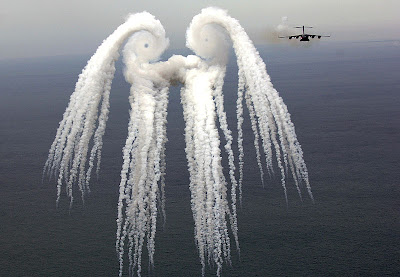 A C-17 Globemaster III from the 14th Airlift Squadron, Charleston Air Force Base, South Carolina. flies off after releasing flares over the Atlantic Ocean near Charleston, South Carolina, during a training mission on Tuesday, May 16, 2006. The "smoke angel" is caused by wing vortices at the plane's wingtips.
http://en.wikipedia.org/wiki/File:C17-Vortex.JPG
Another place where the horseshoe vortex appears, somewhat surprisingly, is beneath the feet of the humble water-strider. The dipolar vortices appear on the surface of the water either side of the water-strider's leg - one rotating clockwise and the other anticlockwise. The vortices are joined beneath the water in a U-shape. These vortices carry sufficient backwards momentum to propel the animal forwards. Thanks to the Nature journal, I found an excellent illustration of how these horseshoe vortices appear beneath the feet of the water-strider:
Vortices carry the momentum to move animals forwards in both air and water, but their pattern varies with the style and speed of locomotion.
http://www.nature.com/nature/journal/v424/n6949/fig_tab/424621a_F1.html
"In a series of experiments, mathematician David L. Hu and coworkers showed that during the rowing stroke, water striders drive their middle legs backwards without penetrating the surface, and can attain speeds of up to 1.5 m/s.
Water striders can stand effortlessly on water due to their non-wetting legs. Writing in Nature, biophysicists Xuefeng Gao and Lei Jiang show that the water resistance of the legs is due to the "special hierarchical structure of the legs, which are covered by large numbers of oriented tiny hairs (microsetae) with fine nanogrooves". They go on to demonstrate that this physical structure is more important than the chemical properties of the wax coating of the legs.
Gao and Jiang used Cassie's law to show that air is trapped in spaces in the microsetae and nanogrooves, forming a cushion at the leg–water interface. This cushion prevents the legs from being wetted."
http://www.redorbit.com/education/reference_library/insects/water_strider/945/index.html
 http://en.wikivisual.com/index.php/Water_strider
"The strider looks as if he has only four legs, forming a giant X pattern on the water. But all insects have six legs and the water strider has two shorter additional legs that are folded up front for grabbing prey. The insect's claws or feet are not at the ends of its legs, but are located farther back so as not to interfere with its delicately balanced water ballet.
The ends of the legs that touch the water are covered with tiny hairs that increase the surface area of contact but are small enough not to break the surface tension of the water. So, in reality, the waft is in the hair! Shaving the legs of a water strider would be a disaster of titanic proportions. The gentle pressure of the hairy legs creates a dimple in the water surface. If seen in direct sunlight, these four dimples cast an enlarged, rounded shadow onto the river bottom if the river is shallow. To the observer, each rounded shadow may appear as a foot pad."
http://www.wafter.org/Water-Strider.php
I'm fascinated by the shadows that are cast by the water-strider - that looks like a human skull grinning back from the river-bed, doesn't it? I realise that these shadows are produced by the dimples on the surface of the water, and that they are not made by the dipolar vortices of the horseshoe vortex, as such. However, looking at the shadows we can see they are very dark - it's as if they convey something which is almost material, something which has DENSITY. It's hard to believe that these shadows are made by dimples on the surface of the water and not by something solid like an object. Is the shadow being produced because the dimple has greater density than the surrounding body of water?
 This photograph was taken on April, 29, 2000 At Montcalm Community College with a Sony FD-91 Digital Camera.~~ Published by the... Physics and Chemistry Departments
Carson City-Crystal High School
The dimples are being produced on the surface of the water by the gentle pressure of the water-strider's leg, and a very simple comparison to make is that it's something like pushing your finger down into the centre of a marshmallow. The marshmallow, or the molecules that make it up, are going to be squished together underneath your finger. In the same way, is it possible that the water-strider's leg is squashing molecules together on the surface of the water? If this was the case, then the dimple would be an area of increasing density, essentially making it a high pressure area.
At the moment, I don't have a confident model for the way that water looks atomically, but I do have some my ideas which differ from mainstream convention (who'd have guessed?). Modern science tends to think of water molecules as constantly vibrating, and running around bouncing off one another - here's an example of the typical explanation:
The molecules of a liquid move around a lot. They bounce off each other and spin around, and slide around from one side of the container to the other. They're always moving relative to each other.
http://www.chemheritage.org/educationalservices/faces/poly/tutorial/states.htm
However, I don't really envision it this way. I think water molecules are made up by donutoms of some description, and that these donutoms are pretty much stationary, except for the spin of their dipolar vortices, and are immersed in the fluid of the aether like cheerios in a bowl of milk; that is, until they are induced to flow from areas of high pressure to areas of low pressure - and for all I know, the molecules in an ordinary glass of water could be stagnant, or in a constant state of flux.
If we return to our dimple, then we have water molecules that are being condensed into a high pressure area. If you look round the periphery of the shadows made by the dimple, you can see that they are surrounded by a rim of bright light. This bright rim surrounds the shadow like a wall, and it appears to have a property that is the exact opposite to the darkness of the dimple's interior - the rim allows light to pass through, and even seems to enhance it. What is the rim of bright light describing in terms of density? One might make the assumption that the rim represents the exact opposite to the increased density that we see inside the dimple, and is thereby an area of low density - an area of low pressure.
Thus, we have an area of high pressure surrounded by a wall of low pressure. We've seen this somewhere before, right? Quite dramatically, the dimple beneath the water-strider's leg seems to echo one of the most famous anticyclone's in the solar system - Jupiter's Great Red Spot. I wonder if the GRS could be used to describe what's happening in the dimple? Another post, perhaps.
Observing the shadows also seems to reveal something interesting about surface tension. Having seen the darkness produced by the interior of the dimple, and the light produced by the rim, then it might be supposed that the surrounding surface water has a density that is somewhere between the two. What we appear to be witnessing is the fabric of the water being stretched like it's made of spandex or something. Assuming that it's not the molecules of water that are being stretched (I know, I know, I'm supposed to hate assumptions!), but the spaces between them, then it stands to reason that we are not only seeing pressure changes in terms of molecular density, but also pressure changes in the aether field.
All fluids are compressible - even water - their density will change as pressure changes, their density increases under increasing pressure. Throughout physics, it is always found that an increase in pressure will increase the density of a material. However, the fluid of the aether is a perfect fluid, and is notoriously incompressible, so any changes in its density must arise from changes in pressure as it passes through the atomic landscape. In much the same way that the diameter of a pipeline affects the pressure experienced by the water. If the diameter of a pipeline is reduced then the velocity of the water in the line must increase to allow the same amount of water to pass through.
As fluid moves from a wider pipe to a narrower one, the volume of that fluid that moves a given distance in a given time period does not change. But since the width of the narrower pipe is smaller, the fluid must move faster (that is, with greater dynamic pressure) in order to move the same amount of fluid the same distance in the same amount of time. One way to illustrate this is to observe the behavior of a river: in a wide, unconstricted region, it flows slowly, but if its flow is narrowed by canyon walls, then it speeds up dramatically.
http://www.answers.com/topic/pressure
If we have molecules tightened together in a high pressure area, then the fluid of the aether shall have less space to move, as it were. Under the constant applied pressure of the Universe, the same volume of aether fluid needs to pass between the molecules, and now that the gaps are smaller, the aether has to speed it up a bit. This is similar to what happens to water coming out of the end of a hose-pipe; if you put your finger over the end you get a jet of water - it's the same volume of water that you had previous to your finger being there, but now in order to get past you, it has to come out faster.
According to Bernoulli's Principle, a fast-moving fluid exerts less static pressure than a slow-moving fluid. The flow between narrow canyon walls is faster moving, and has a greater velocity than the water flowing in the wide river. The faster a fluid moves, the greater its velocity pressure, or dynamic pressure, then the smaller the static pressure it exerts on the sides. The pressure in a static fluid arises from the weight of the fluid. A fast moving fluid exerts less pressure than a slower moving fluid.
Total pressure is the sum of dynamic and static pressures. A fluid at rest in a pipe exerts static pressure on the walls. The pressure in a static fluid arises from the weight of the fluid. Dynamic pressure arises from the motion of the fluid, and is not really a pressure at all, but merely represents the decrease in pressure due to the velocity of the fluid. The faster a fluid moves, the greater its dynamic pressure and the smaller the static pressure it exerts on the sides.
Thus, the fluid of the aether in the dimple's interior is moving under high dynamic pressure, and thereby imparts less static pressure. However, in the rim surrounding the dimple, there are fewer molecules present, meaning that this area has less density, giving the aether fluid plenty more room to manoeuvre, and we now see courses which are wide and shallow, where the aether exerts less dynamic pressure, and greater static pressure. If the aether fluid has a greater static pressure, it then has greater density, and shall act upon the molecules by pushing them apart (just think of Chewbacca holding out his arms and pushing against the sides of the compactor). I think that is this "push" which could prove to be highly relevant to surface tension.
The density of water increases with depth. For example, if we look at a glass of water - the molecules on the surface of the water are not as squished as the molecules of water at the bottom of the glass. With increasing density the molecules are getting squeezed tighter together, while those on the water's surface are enjoying relatively greater freedom - they are not packed so closely together. This means that the fluid of the aether is under greater static pressure on the surface of the water. I wonder if this increased static pressure in the aether field is revealing something about the tension described by the water's surface?
Many thanks:
http://www.teachersdomain.org/resource/phy03.sci.phys.matter.zclip/
http://oac.med.jhmi.edu/res_phys/Encyclopedia/AirFlow/AirFlow.HTML
http://mysite.du.edu/~jcalvert/phys/bubbles.htm
http://www.physlink.com/education/askexperts/ae681.cfm
http://www.cvphysiology.com/Hemodynamics/H007.htm
http://hyperphysics.phy-astr.gsu.edu/Hbase/pber.html
http://www.efm.leeds.ac.uk/CIVE/CIVE1400/Section4/laminar_turbulent.htm
http://www.centennialofflight.gov/essay/Theories_of_Flight/Real_Fluid_Flow/TH9.htm http://www.funsci.com/fun3_en/exper2/exper2.htm
http://www.brighthub.com/engineering/civil/articles/47264.aspx
http://www.newton.dep.anl.gov/askasci/eng99/eng99439.htm
http://www.sdahq.org/cleaning/chemistry/
http://en.wikisource.org/wiki/The_Forces_of_Matter/Cohesion—Chemical_Affinity
http://www.science.uwaterloo.ca/~cchieh/cact/c123/liquid.html
http://en.wikipedia.org/wiki/Density
http://www.geagolf.com/GEA%20Pressure%20and%20Flow.html
http://science.jrank.org/pages/97/Aerodynamics.html
http://water.me.vccs.edu/courses/CIV240/lesson4.htm
http://www.ac.wwu.edu/~vawter/PhysicsNet/Topics/Pressure/HydroStatic.html
http://answers.yahoo.com/question/index?qid=20080819161700AA53xsp
http://www.letstalkphysics.com/2008/03/surface-tension-and-floating-needle.html
http://www.sciencenews.org/view/generic/id/56546/title/FOR_KIDS_Cold,_colder_and_coldest_ice http://www.inkyfingers.com/pyrates/flags/
Peter Pan: You know the rules, Hook. A good captain always goes down with his ship.
Captain Hook: I dont want to be a good captain!
~~Return to Never Land (2002)
A smoke ring is a great example of a vortex ring. If you were to slice a smoke ring down the middle, it would leave you with something that looks like half a bundt cake - a u-shape. Each end of the "u" would appear to you as a vortex, giving you two vortices. The two vortices rotate in different directions, one clockwise and the other counter-clockwise. As we are in the Northern hemisphere, bias dictates that clockwise is anticyclonic. Thereby, the vortex moving in the counter-clockwise direction is cyclonic. As part of a closed system, the two vortices are known as dipolar vortices. With the dipolar vortices working together like this in a closed loop system, you get a vortex ring, a ring donut.
According to Bernoulli's Principle, the density of a fluid increases with pressure. The density increases as pressure increases. A slower moving fluid exerts a higher pressure than fast moving fluids. An anticyclone is a high pressure system, meaning that pressure increases as you move from the periphery to the centre, because the fluid is moving more slowly at the centre. Certain weather conditions are associated with high and low pressure systems. The dynamics of a high pressure system is that fluid moves downward vertically, as opposed to a cyclonic, low pressure system where fluid moves vertically upward.
High pressure areas, or highs, are shown by "H" symbols. In a high pressure system, air pressure is greater than the surrounding areas. This difference in air pressure results in wind, or moving air. In a high pressure area, air is more dense than in areas of lower pressure. The result is that air will move from the high pressure area to an area of less density, or lower pressure. Winds blow away from high pressure areas toward areas having lower air pressure. http://www.ussartf.org/predicting_weather.htm
It is possible to find examples of the vortex ring where it has been "halved" in such a way to expose the dipolar vortices, and is commonly referred to as a U-vortex, or horseshoe vortex. The horseshoe vortex is well-known in aviation, where they are produced by the wings of a plane as it moves through the fluid of the air. The horseshoe vortex is responsible for the trailing vortices that you might see leaving the wing tips of aircraft. The vortices are only visible because the lower pressure in the region lowers the temperature, and if it drops below the local dew-point, we see the condensed water vapor. In fluid dynamics it is accepted that the horseshoe vortex is not open as such, but is in reality part of a closed vortex loop.
 A C-17 Globemaster III from the 14th Airlift Squadron, Charleston Air Force Base, South Carolina. flies off after releasing flares over the Atlantic Ocean near Charleston, South Carolina, during a training mission on Tuesday, May 16, 2006. The "smoke angel" is caused by wing vortices at the plane's wingtips.
http://en.wikipedia.org/wiki/File:C17-Vortex.JPG

Another place where the horseshoe vortex appears, somewhat surprisingly, is beneath the feet of the humble water-strider. The dipolar vortices appear on the surface of the water either side of the water-strider's leg - one rotating clockwise and the other anticlockwise. The vortices are joined beneath the water in a U-shape. These vortices carry sufficient backwards momentum to propel the animal forwards. Thanks to the Nature journal, I found an excellent illustration of how these horseshoe vortices appear beneath the feet of the water-strider:
Vortices carry the momentum to move animals forwards in both air and water, but their pattern varies with the style and speed of locomotion.
http://www.nature.com/nature/journal/v424/n6949/fig_tab/424621a_F1.html

"In a series of experiments, mathematician David L. Hu and coworkers showed that during the rowing stroke, water striders drive their middle legs backwards without penetrating the surface, and can attain speeds of up to 1.5 m/s.
Water striders can stand effortlessly on water due to their non-wetting legs. Writing in Nature, biophysicists Xuefeng Gao and Lei Jiang show that the water resistance of the legs is due to the "special hierarchical structure of the legs, which are covered by large numbers of oriented tiny hairs (microsetae) with fine nanogrooves". They go on to demonstrate that this physical structure is more important than the chemical properties of the wax coating of the legs.
Gao and Jiang used Cassie's law to show that air is trapped in spaces in the microsetae and nanogrooves, forming a cushion at the leg–water interface. This cushion prevents the legs from being wetted."
http://www.redorbit.com/education/reference_library/insects/water_strider/945/index.html
 http://en.wikivisual.com/index.php/Water_strider
"The strider looks as if he has only four legs, forming a giant X pattern on the water. But all insects have six legs and the water strider has two shorter additional legs that are folded up front for grabbing prey. The insect's claws or feet are not at the ends of its legs, but are located farther back so as not to interfere with its delicately balanced water ballet.
The ends of the legs that touch the water are covered with tiny hairs that increase the surface area of contact but are small enough not to break the surface tension of the water. So, in reality, the waft is in the hair! Shaving the legs of a water strider would be a disaster of titanic proportions. The gentle pressure of the hairy legs creates a dimple in the water surface. If seen in direct sunlight, these four dimples cast an enlarged, rounded shadow onto the river bottom if the river is shallow. To the observer, each rounded shadow may appear as a foot pad."
http://www.wafter.org/Water-Strider.php
I'm fascinated by the shadows that are cast by the water-strider - that looks like a human skull grinning back from the river-bed, doesn't it? I realise that these shadows are produced by the dimples on the surface of the water, and that they are not made by the dipolar vortices of the horseshoe vortex, as such. However, looking at the shadows we can see they are very dark - it's as if they convey something which is almost material, something which has DENSITY. It's hard to believe that these shadows are made by dimples on the surface of the water and not by something solid like an object. Is the shadow being produced because the dimple has greater density than the surrounding body of water?
 This photograph was taken on April, 29, 2000 At Montcalm Community College with a Sony FD-91 Digital Camera.~~ Published by the... Physics and Chemistry Departments
Carson City-Crystal High School
The dimples are being produced on the surface of the water by the gentle pressure of the water-strider's leg, and a very simple comparison to make is that it's something like pushing your finger down into the centre of a marshmallow. The marshmallow, or the molecules that make it up, are going to be squished together underneath your finger. In the same way, is it possible that the water-strider's leg is squashing molecules together on the surface of the water? If this was the case, then the dimple would be an area of increasing density, essentially making it a high pressure area.
At the moment, I don't have a confident model for the way that water looks atomically, but I do have some my ideas which differ from mainstream convention (who'd have guessed?). Modern science tends to think of water molecules as constantly vibrating, and running around bouncing off one another - here's an example of the typical explanation:
The molecules of a liquid move around a lot. They bounce off each other and spin around, and slide around from one side of the container to the other. They're always moving relative to each other.
http://www.chemheritage.org/educationalservices/faces/poly/tutorial/states.htm
However, I don't really envision it this way. I think water molecules are made up by donutoms of some description, and that these donutoms are pretty much stationary, except for the spin of their dipolar vortices, and are immersed in the fluid of the aether like cheerios in a bowl of milk; that is, until they are induced to flow from areas of high pressure to areas of low pressure - and for all I know, the molecules in an ordinary glass of water could be stagnant, or in a constant state of flux.
If we return to our dimple, then we have water molecules that are being condensed into a high pressure area. If you look round the periphery of the shadows made by the dimple, you can see that they are surrounded by a rim of bright light. This bright rim surrounds the shadow like a wall, and it appears to have a property that is the exact opposite to the darkness of the dimple's interior - the rim allows light to pass through, and even seems to enhance it. What is the rim of bright light describing in terms of density? One might make the assumption that the rim represents the exact opposite to the increased density that we see inside the dimple, and is thereby an area of low density - an area of low pressure.
Thus, we have an area of high pressure surrounded by a wall of low pressure. We've seen this somewhere before, right? Quite dramatically, the dimple beneath the water-strider's leg seems to echo one of the most famous anticyclone's in the solar system - Jupiter's Great Red Spot. I wonder if the GRS could be used to describe what's happening in the dimple? Another post, perhaps.
Observing the shadows also seems to reveal something interesting about surface tension. Having seen the darkness produced by the interior of the dimple, and the light produced by the rim, then it might be supposed that the surrounding surface water has a density that is somewhere between the two. What we appear to be witnessing is the fabric of the water being stretched like it's made of spandex or something. Assuming that it's not the molecules of water that are being stretched (I know, I know, I'm supposed to hate assumptions!), but the spaces between them, then it stands to reason that we are not only seeing pressure changes in terms of molecular density, but also pressure changes in the aether field.
All fluids are compressible - even water - their density will change as pressure changes, their density increases under increasing pressure. Throughout physics, it is always found that an increase in pressure will increase the density of a material. However, the fluid of the aether is a perfect fluid, and is notoriously incompressible, so any changes in its density must arise from changes in pressure as it passes through the atomic landscape. In much the same way that the diameter of a pipeline affects the pressure experienced by the water. If the diameter of a pipeline is reduced then the velocity of the water in the line must increase to allow the same amount of water to pass through.
As fluid moves from a wider pipe to a narrower one, the volume of that fluid that moves a given distance in a given time period does not change. But since the width of the narrower pipe is smaller, the fluid must move faster (that is, with greater dynamic pressure) in order to move the same amount of fluid the same distance in the same amount of time. One way to illustrate this is to observe the behavior of a river: in a wide, unconstricted region, it flows slowly, but if its flow is narrowed by canyon walls, then it speeds up dramatically.
http://www.answers.com/topic/pressure
If we have molecules tightened together in a high pressure area, then the fluid of the aether shall have less space to move, as it were. Under the constant applied pressure of the Universe, the same volume of aether fluid needs to pass between the molecules, and now that the gaps are smaller, the aether has to speed it up a bit. This is similar to what happens to water coming out of the end of a hose-pipe; if you put your finger over the end you get a jet of water - it's the same volume of water that you had previous to your finger being there, but now in order to get past you, it has to come out faster.
According to Bernoulli's Principle, a fast-moving fluid exerts less static pressure than a slow-moving fluid. The flow between narrow canyon walls is faster moving, and has a greater velocity than the water flowing in the wide river. The faster a fluid moves, the greater its velocity pressure, or dynamic pressure, then the smaller the static pressure it exerts on the sides. The pressure in a static fluid arises from the weight of the fluid. A fast moving fluid exerts less pressure than a slower moving fluid.
Total pressure is the sum of dynamic and static pressures. A fluid at rest in a pipe exerts static pressure on the walls. The pressure in a static fluid arises from the weight of the fluid. Dynamic pressure arises from the motion of the fluid, and is not really a pressure at all, but merely represents the decrease in pressure due to the velocity of the fluid. The faster a fluid moves, the greater its dynamic pressure and the smaller the static pressure it exerts on the sides.
Thus, the fluid of the aether in the dimple's interior is moving under high dynamic pressure, and thereby imparts less static pressure. However, in the rim surrounding the dimple, there are fewer molecules present, meaning that this area has less density, giving the aether fluid plenty more room to manoeuvre, and we now see courses which are wide and shallow, where the aether exerts less dynamic pressure, and greater static pressure. If the aether fluid has a greater static pressure, it then has greater density, and shall act upon the molecules by pushing them apart (just think of Chewbacca holding out his arms and pushing against the sides of the compactor). I think that is this "push" which could prove to be highly relevant to surface tension.
The density of water increases with depth. For example, if we look at a glass of water - the molecules on the surface of the water are not as squished as the molecules of water at the bottom of the glass. With increasing density the molecules are getting squeezed tighter together, while those on the water's surface are enjoying relatively greater freedom - they are not packed so closely together. This means that the fluid of the aether is under greater static pressure on the surface of the water. I wonder if this increased static pressure in the aether field is revealing something about the tension described by the water's surface?
Many thanks:
http://www.teachersdomain.org/resource/phy03.sci.phys.matter.zclip/
http://oac.med.jhmi.edu/res_phys/Encyclopedia/AirFlow/AirFlow.HTML
http://mysite.du.edu/~jcalvert/phys/bubbles.htm
http://www.physlink.com/education/askexperts/ae681.cfm
http://www.cvphysiology.com/Hemodynamics/H007.htm
http://hyperphysics.phy-astr.gsu.edu/Hbase/pber.html
http://www.efm.leeds.ac.uk/CIVE/CIVE1400/Section4/laminar_turbulent.htm
http://www.centennialofflight.gov/essay/Theories_of_Flight/Real_Fluid_Flow/TH9.htm http://www.funsci.com/fun3_en/exper2/exper2.htm
http://www.brighthub.com/engineering/civil/articles/47264.aspx
http://www.newton.dep.anl.gov/askasci/eng99/eng99439.htm
http://www.sdahq.org/cleaning/chemistry/
http://en.wikisource.org/wiki/The_Forces_of_Matter/Cohesion—Chemical_Affinity
http://www.science.uwaterloo.ca/~cchieh/cact/c123/liquid.html
http://en.wikipedia.org/wiki/Density
http://www.geagolf.com/GEA%20Pressure%20and%20Flow.html
http://science.jrank.org/pages/97/Aerodynamics.html
http://water.me.vccs.edu/courses/CIV240/lesson4.htm
http://www.ac.wwu.edu/~vawter/PhysicsNet/Topics/Pressure/HydroStatic.html
http://answers.yahoo.com/question/index?qid=20080819161700AA53xsp
http://www.letstalkphysics.com/2008/03/surface-tension-and-floating-needle.html
http://www.sciencenews.org/view/generic/id/56546/title/FOR_KIDS_Cold,_colder_and_coldest_ice http://www.inkyfingers.com/pyrates/flags/
Subscribe to:
Posts (Atom)